Presenting: Alan Turing
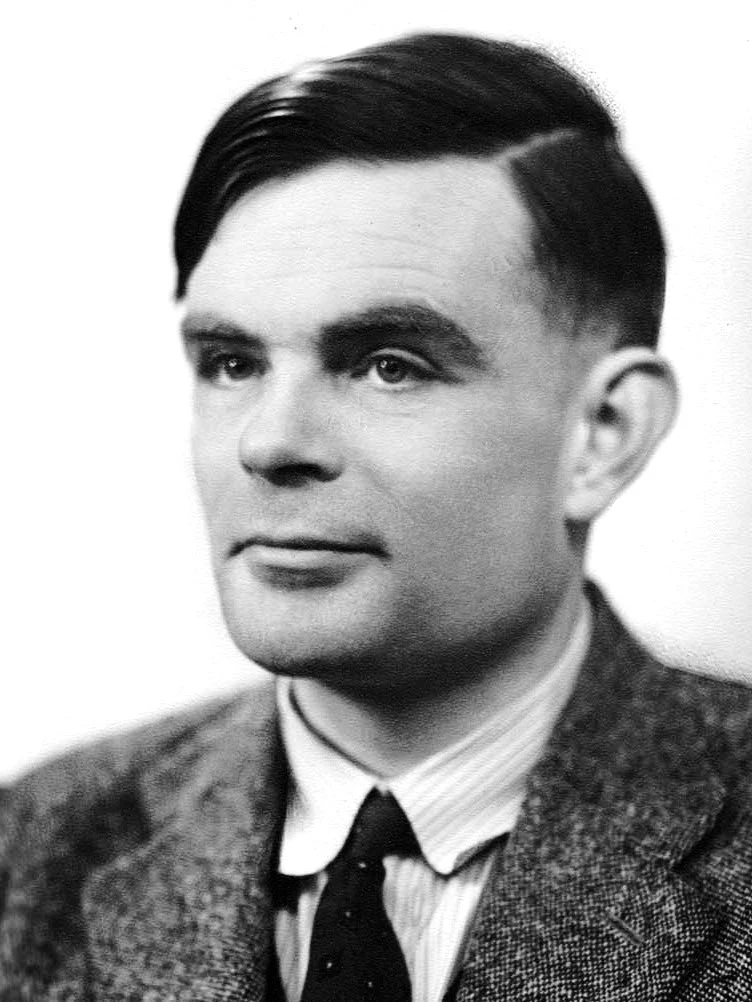
Alan Turing. Source: Wikimedia Commons
Imagine for a moment that thinking does not require a soul. Imagine that logic, memory, and deduction are not a biological miracle, but a purely mechanical process that gears, paper tape, or electricity could replicate. Today, surrounded by smartphones and ChatGPT, this seems obvious. But in the 1930s, thinking this way was close to scientific heresy. And the absolute prophet of that heresy was Alan Mathison Turing.
He was born in 1912 in London and died tragically in 1954 in Wilmslow, England [1]. Turing was not just a brilliant mathematician; he was a cryptanalyst, a philosopher, a pioneering biologist, and an Olympic-level marathon runner. His mind operated on a frequency no one else could tune into. While others were busy solving equations, he invented the concepts of “software” and “hardware” out of thin air, shortened the Second World War, and laid the philosophical foundations of artificial intelligence.
The work that immortalized his name was published in 1936, when he was only 24 years old [2]. The central idea was so simple it is chilling: any calculation a human mind can conceive can be replicated by a machine that only knows how to read, write, and erase marks on an infinite paper tape. The consequences of that 36-page paper did not just revolutionize mathematics; they built the entirety of our modern reality.
The engine of obsession: the ghost in the machine
To understand Turing, you have to look first not at his mathematics, but at his heart. As a lonely teenager at Sherborne boarding school, he fell deeply in love with a brilliant classmate named Christopher Morcom. Morcom introduced Turing to advanced science and gave him a sense of belonging. Tragically, Christopher died of bovine tuberculosis at age 18 [1].
The death of his first and greatest love devastated Turing. In a desperate attempt to deal with the grief, the young Alan became obsessed with an existential question: where did Christopher’s mind go? Could thought survive the death of the biological body? [3]
This personal tragedy led him to separate “mind” from “matter.” If the mind was just a complex pattern of information processing, then it did not need a biological brain to exist; it could, in theory, exist in a machine. Turing did not invent the computer out of a pure interest in engineering; he invented it, in large part, trying to understand the mechanics of the soul and the human mind [1].
The problem before Turing
To understand what changed, we have to go back to the mathematical headache of the era: the Entscheidungsproblem (the Decision Problem), posed by David Hilbert in 1928.
Hilbert wanted to know whether there existed a “mechanical process” (a definitive algorithm) that, given any mathematical statement, could tell you with 100% certainty whether it was true or false [3]. Gödel, as we saw in the previous article, had already shown with his incompleteness theorem that not every truth can be proven.
But Turing attacked the problem in a completely different way, almost like science fiction. While everyone else was working with abstract symbols, Turing said: “To talk about mechanical processes, I first have to invent an imaginary machine.”
The paper tape that held the world
Suppose you have a human being with a pencil, an eraser, and an infinite notebook, following strict rules to solve a sum. Turing distilled this human behavior into what became known as the Turing machine:
A theoretical machine with:
- An infinite tape divided into cells (memory).
- A head that can read, write, or erase a symbol (0 or 1) on the current cell.
- A rulebook that tells the head what to do based on the symbol it just read and its current internal state.
With this, Turing proved the Decision Problem has no solution: he invented the famous halting problem, showing that no algorithm exists that can predict whether a Turing machine will finish its calculation or get stuck in an infinite loop forever [2].
But here comes the greatest flash of genius in human history: on page 24 of his paper, Turing described a “universal Turing machine.” It was a machine that could read the rules of any other machine from the tape and simulate it. He had just invented the modern computer. The hardware (the universal machine) could run any software (the rules on the tape) [1], [3].
Intelligence does not require biology
This is where his theory leapt into philosophy.
Fourteen years later, in 1950, Turing published another explosive paper titled “Computing Machinery and Intelligence,” which opened with the line: “I propose to consider the question, ‘Can machines think?’” [4]
Turing knew that debating what “thinking” meant was pointless, so he proposed an imitation game instead: the famous Turing test. If a human judge communicates by text with a machine and with a human, and cannot tell which is which, then, for all practical purposes, the machine thinks.
Turing was not trying to create consciousness. He was arguing against biological chauvinism. He suggested that if a system processes information and exhibits cognitive behavior indistinguishable from ours, denying it the label “intelligent” just because it is made of silicon instead of carbon is pure human prejudice [4].
The limits of the idea and the questions it left open
Turing’s legacy closed mathematical debates, but his final research opened entire fields we still do not fully understand:
-
Morphogenesis. In his final years, Turing left computing behind and moved into chemical biology. He used complex mathematics to explain how a group of symmetrical cells suddenly “knows” it should become a leopard’s spots or a zebra’s stripes (the Turing pattern). His question is still alive: is biology itself just another kind of computational program running in nature? [5]
-
Oracle machines. Turing knew his machine had logical limits. He imagined “oracle machines,” computers equipped with a “black box” capable of solving uncountable problems in a single step (something like human intuition). Theoretical computer scientists today still debate whether the human brain is a standard Turing machine or an oracle machine.
-
True AI. Turing predicted machines would pass his test by the year 2000. He was off by a few decades, but today, with large language models, we are exactly inside Turing’s dilemma: our machines act intelligently, but we are still debating philosophically whether they actually understand what they say.
When the system defeats a war
If the Turing machine had been only a mathematical paper, it would already be immortal. But Turing brought it down to Earth exactly when the world needed it most.
During the Second World War, Turing moved to Bletchley Park and led the Hut 8 team tasked with breaking the German Enigma code machine. Turing designed the Bombe, a monstrous electromechanical machine that automated deductive reasoning to rule out incorrect Enigma settings at superhuman speed. Thanks to Turing’s work (and the application of Bayes’ theorem), the Allies were able to read the secret messages of Nazi submarines. His work is estimated to have shortened the war by two years and saved around 14 million lives [1].
In a nutshell: the gossip on Alan Turing
If we had to sum up Turing’s spectacular and tragic life in a hallway:
Alan Turing was an eccentric, openly gay genius at a time when both of those things got you in trouble. He rode his bike to work wearing a gas mask to deal with his allergies, and he chained his teacup to the radiator with a padlock so no one would steal it. As a teenager, he lost the boy he loved, and while trying to figure out whether his friend’s soul had survived, he ended up inventing the concepts of computers, hardware, and software inside his own head.
When the Second World War broke out, this same introverted mathematician built a giant machine that hacked the Nazis’ communications, literally saving millions of lives and secretly winning the war. But instead of a medal, the British government repaid him in the worst way possible. Years after the war, they discovered he was gay, prosecuted him criminally, and forced him into chemical castration. Physically and mentally shattered, Turing died at 41 after biting into an apple laced with cyanide. The man who taught machines how to think was destroyed by the relentless inhumanity of his own creators.
References
[1] A. Hodges, Alan Turing: The Enigma. London, UK: Burnett Books, 1983. (The definitive biography and the main source on his relationship with Morcom and his work at Bletchley Park.)
[2] A. M. Turing, “On Computable Numbers, with an Application to the Entscheidungsproblem,” Proceedings of the London Mathematical Society, vol. s2-42, no. 1, pp. 230 to 265, 1936.
[3] B. J. Copeland, The Essential Turing: Seminal Writings in Computing, Logic, Philosophy, Artificial Intelligence, and Artificial Life plus The Secrets of Enigma. Oxford, UK: Oxford University Press, 2004.
[4] A. M. Turing, “Computing Machinery and Intelligence,” Mind, vol. LIX, no. 236, pp. 433 to 460, Oct. 1950.
[5] A. M. Turing, “The Chemical Basis of Morphogenesis,” Philosophical Transactions of the Royal Society of London, Series B, Biological Sciences, vol. 237, no. 641, pp. 37 to 72, Aug. 1952.