Presenting: Kurt Gödel
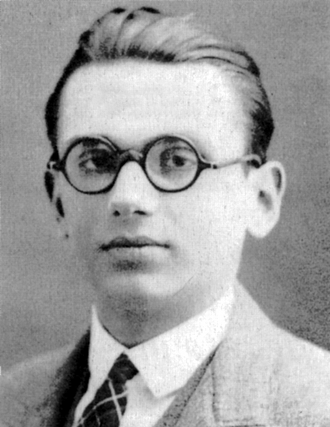
Kurt Gödel. Source: Wikimedia Commons
Some mathematicians spend their careers building imposing structures of logic and numbers on foundations they assume are solid. Others climb down to examine those foundations and prove mathematically that the building has unbridgeable cracks and can never be finished. Kurt Gödel definitely belonged to the second kind.
He was born in 1906 in Brünn, Austria-Hungary (today Brno, Czech Republic), and died tragically in 1978 in Princeton, United States [1]. His contributions were not limited to solving difficult equations; he permanently changed our understanding of what mathematics can and cannot do. He was not a builder of machines or an analyst of data; he was the greatest logician since Aristotle. His greatest legacy came from destroying the most optimistic dream of exact science.
The work that puts his name in this article was published in 1931, when he was only 25 years old. He published a stunning paper on “formally undecidable propositions” [2]. The central idea sounds almost like a magic trick when stated informally: in any logical system complex enough to do basic arithmetic, there will always be mathematical truths that are impossible to prove. The consequences of that premise shook all of philosophy and science.
That became what we now call Gödel’s incompleteness theorems, and it changes a surprisingly basic question. Instead of asking how we can prove this statement is true, Gödel forced us to accept that truth and provability are not the same thing.
The engine of paranoia: the life of “Mr. Why”
To understand Gödel’s work, you have to understand his hyper-logical, fragile mind. As a child, his family nicknamed him Herr Warum (“Mr. Why”), for his insatiable curiosity and his refusal to accept anything without an absolute justification [3].
Gödel did not study logic for practical applications; he did it because he saw mathematics as eternal truths, independent of the human mind, a philosophical position known as mathematical Platonism. Yet his brilliance came paired with deep paranoia and anxiety [1]. After escaping the Nazi regime to the United States, he settled at the Institute for Advanced Study in Princeton, where his only close friend was Albert Einstein. Einstein admitted that in his later years his own work no longer mattered so much to him, and that he went to his office “just to have the privilege of walking home with Gödel” [3].
What drove him to study incompleteness? The need to find absolute limits. Gödel was so obsessively logical that he applied that rigor to everything. Tragically, that same paranoid logic cost him his life. In his final years, he became convinced that someone was trying to poison him. He only ate what his devoted wife, Adele, tasted first. When she was hospitalized for several months and could not taste his food, Gödel refused to eat. He starved himself to death at 71, weighing barely 29 kilograms, a victim of his own logical spiral [1], [5].
The problem before Gödel
To understand what changed, it helps to recall the monumental mathematical optimism of the early twentieth century.
Before Gödel, Hilbert’s Program reigned. The great mathematician David Hilbert had proposed a definitive challenge: he wanted all of mathematics grounded in a set of solid axioms and irrefutable logical rules. Hilbert believed mathematics should be complete (every true statement must be provable) and consistent (the system must never lead to contradictions, such as proving that 1 = 0) [4].
Hilbert’s famous motto was: “Wir müssen wissen. Wir werden wissen” (We must know. We will know). Figures like Bertrand Russell and Alfred North Whitehead spent years writing Principia Mathematica, a gigantic book trying to prove that absolutely everything in mathematics could be derived from pure logic. Gödel wanted to know whether that dream was possible. And he discovered it was not.
Truth is bigger than proof
Suppose you have a book of perfect mathematical rules. Gödel’s first incompleteness theorem states that if your system is consistent, it cannot be complete.
How did he do it? Gödel invented a brilliant trick called Gödel numbering. He assigned a unique number to every mathematical symbol, equation, and logical rule. This way, he made mathematics capable of “talking about itself.” He managed to write a mathematical equation that, when translated back into words, literally said:
“This statement cannot be proven within the system.”
Here is the trap that destroyed Hilbert’s dream:
- If the statement is false, that means it can in fact be proven. But if you can prove something false, your mathematical system is inconsistent, it is broken.
- If the statement is true, then it literally cannot be proven. Therefore, your system is incomplete, there are truths that escape your proofs.
The important word here is not paradox. It is limit. Gödel proved mathematically that there are objective truths in the universe that we will never be able to prove using formal logic [2], [4].
Incompleteness does not mean relativism
This is where the theory is easy to misread, and has been badly abused.
Consider postmodern philosophers. Many have used Gödel to say: “See? Mathematics is broken. Nothing is certain. All truth is relative or subjective.” This infuriated Gödel.
Gödel did not destroy truth; in fact, he elevated it [3]. The theorem does not say mathematics is false or doubtful. What it says is that objective truth exists and is bigger and vaster than any human system of rules. Mathematics is not a game of symbols we invented; it is a real, Platonic world our minds have imperfect access to. The limitation is in our language and our rules, not in the reality of numbers.
The limits of the idea and the questions it left open
Gödel’s work closed an era in mathematics, but opened philosophical chasms we are still exploring:
-
The human mind versus artificial intelligence. If any computing machine (formal system) has mathematical truths it cannot prove, but humans can see that Gödel’s statement is true, does this mean the human mind does something that is not computable? The physicist Roger Penrose has argued forcefully that Gödel’s theorems prove artificial intelligence will never match human intuition [5]. It remains a fierce debate today.
-
The continuum hypothesis. Gödel became obsessed with Georg Cantor’s different sizes of infinity. He proved half of one of the hardest problems in mathematics (that the continuum hypothesis cannot be disproven using the standard axioms). Decades later, Paul Cohen proved the other half (that it cannot be proven either). Gödel exposed that parts of mathematics simply float in an undecidable limbo.
-
Time does not exist. In his spare time, for Einstein’s 70th birthday, Gödel solved the equations of general relativity and found mathematically possible universes where time loops back on itself (Gödel universes). He showed that if time travel is possible within the equation, then the “passage of time” is a human illusion.
When the system collides with computation
If Hilbert dreamed of a perfect mathematical machine, Gödel proved the machine has limits. But in proving those limits, he gave birth to computer science.
Alan Turing read Gödel’s paper and was inspired to bring the idea into the physical world. Turing created the concept of the Turing machine (the first conceptual computer) precisely to demonstrate Gödel’s incompleteness from another angle: the famous halting problem, showing that there are problems no computer, no matter how much time it has, will ever be able to solve. Without Gödel’s destructive logic, we would not have modern computer science.
In a nutshell: the gossip on Kurt Gödel
If we had to sum up this whole story informally:
Kurt Gödel was the ultimate nerd among history’s geniuses, to such an extreme degree that Albert Einstein himself considered him an equal. In the 1920s, every mathematician in the world was super excited trying to write the “Ultimate Book of Rules,” believing that sooner or later they could solve absolutely every mystery of the universe with pure mathematical logic.
Gödel, at 25, basically crashed the party. Using mathematics’ own rules against it, he wrote an equation that said: “You will never be able to prove this equation.” And he was right. He broke the system forever by proving that truth is bigger than our tools for measuring it.
But his brain, so brilliant at logic, could not handle messy reality. When he went to take his exam to become a US citizen, he studied the American Constitution with the same mathematical rigor and found a legal loophole that, in his view, would let the country legally become a fascist dictatorship. Einstein had to go with him to the exam just to distract him so he would not try to give the immigration judge a lecture on logic and get deported. In the end, his own logic consumed him: convinced everyone wanted to poison him, he refused to eat and starved to death. The man who placed limits on mathematics never managed to place limits on his own mind.
References
[1] J. W. Dawson, Logical Dilemmas: The Life and Work of Kurt Gödel. Wellesley, MA: A K Peters, 1997.
[2] K. Gödel, “Über formal unentscheidbare Sätze der Principia Mathematica und verwandter Systeme I,” Monatshefte für Mathematik und Physik, vol. 38, pp. 173 to 198, 1931.
[3] R. Goldstein, Incompleteness: The Proof and Paradox of Kurt Gödel. New York, NY: W. W. Norton & Company, 2005.
[4] E. Nagel and J. R. Newman, Gödel’s Proof. New York, NY: New York University Press, 1958.
[5] H. Wang, A Logical Journey: From Gödel to Philosophy. Cambridge, MA: MIT Press, 1996.